

Broadband Produces Employment

crandall.jpg
lehr.jpg
Litan.jpg
Many have assumed that broadband is good for the economy; now here’s a study with rivets:
More specifically, for every one percentage point increase in broadband penetration in a state, employment is projected to increase by 0.2 to 0.3 percent per year.

The Effects of Broadband Deployment on Output and Employment: A Cross-sectional Analysis of U.S. Data, By Robert Crandall, William Lehr and Robert Litan, Brookings Institution, 2007

Of course, this is like saying every state in medieval Germany that had a printing press produced employment in the printing industry. There are economic and social effects far beyond mere employment. What should be done?

The paper has a few recommendations:

The surest route to lower prices is provided by increasing competition in the delivery of broadband services.
Continue reading

Broadband in Two Countries

BBArussfig1070702.gif Broadband growth is slowing in the U.S.:
Price reductions and other factors led to 40 percent growth in adoption from March 2005 to March 2006. Over the following year, growth was a more modest 12 percent, the Pew Internet and American Life Project said in a report Tuesday.

“The low-hanging fruit was picked … so you saw a slowdown understandably going to 2007,” said John Horrigan, Pew’s associate director for research.

Study: Broadband Growth Slowing in U.S. By Anick Jesdanun, AP Internet Writer, 3 July 2007

Meanwhile, back in the USSR Russia:
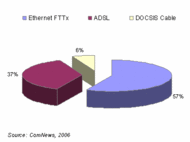
The broadband market in Russia, particularly in Moscow, is growing quickly. The Ministry of IT and Communications reports that the fixed broadband market grew 42% and wireless broadband market showed a 61% annual growth rate in 2006.

FTTx and DSL in tussle for Moscow market share, PointTopic, 3 July 2007

And in Russia it’s mostly fiber to the home, enabling even faster future speeds.

-jsq

The Tree of Liberty

On this day in the United States we celebrate the Declaration of Independence with
Pomp and Parade, with Shews, Games, Sports, Guns, Bells, Bonfire and Illuminations
as John Adams recommended in 1776.

The Declaration laid out a “a long train of abuses and usurpations” and referred to “certain unalienable Rights”, which the former colonials went on to spell out in a written Constitution (the oldest in the world today) to which they added a Bill of Rights. Is their work done? Continue reading

iPhone Plus

You do want fries with that iPhone, don’t you?
Following up on the launch difference between AT&T and Apple stores, we’ve got three separate accounts of people reporting that AT&T is forcing them to buy accessories along with their iPhone at three different AT&T stores. This was definitely not the case at Apple stores, and for AT&T to decide this on their own to cash in on the launch is pretty damn shady.

Breaking: Several AT&T Stores Forced Customers to Buy Accessories With iPhone By Jason Chen, Gizmodo, 30 June 2007

This is even though the iPhone costs about $500 because it is not subsidized by the telco (unlike most other phones they sell, which can cost $0), yet you’re still required to sign up for a two year contract. And AT&T is one of the companies we’re supposed to trust to provide us Internet service without charging extra for particular services.

-jsq

A FiOS Way

thomas_t.jpg Verizon has a policy blog. It’s been around for most of a year now:
I’ll leave clever humor comparing this blog’s name with the terminology for amphibious offspring to others, yet in one sense the comparison is appropriate. “PoliBlog” is very much a site in its infancy, and none of us here at Verizon is sure how it will evolve. But evolve it will.

The intent of PoliBlog is to present perspectives on issues of importance that intersect public policy, politics, markets, and business in the broadband world. That’s a big pool to swim in, and it reflects the constantly changing world we live in.

, Welcome Aboard, by Tom Tauke, PolicyBlog, October 02, 2006

I have to give them points for seeing it as an emergent communication method including their point of view, rather than just dictating talking points.So far, they seem to be sticking to that. And they’re getting some interesting comments, pro and con. But let’s look outside their blog box a bit. Continue reading

FTC: What, Me Worry?

majoras.jpg The U.S. Federal Trade Commission (FTC) says there’s no need for net neutrality:
FTC Chairwoman Deborah Platt Majoras said that without evidence of “market failure or demonstrated consumer harm, policy makers should be particularly hesitant to enact new regulation in this area.”
So in a “market” where the average customer has at most two choices, we’re supposed to wait for a market failure? Continue reading

Something the Customers Wanted

records.jpg Sometimes not listening to customers can be fatal to an industry:
While there are factors outside of the labels’ control — from the rise of the Internet to the popularity of video games and DVDs — many in the industry see the last seven years as a series of botched opportunities. And among the biggest, they say, was the labels’ failure to address online piracy at the beginning by making peace with the first file-sharing service, Napster. “They left billions and billions of dollars on the table by suing Napster — that was the moment that the labels killed themselves,” says Jeff Kwatinetz, CEO of management company the Firm. “The record business had an unbelievable opportunity there. They were all using the same service. It was as if everybody was listening to the same radio station. Then Napster shut down, and all those 30 or 40 million people went to other [file-sharing services].”

The Record Industry’s Decline, Record sales are tanking, and there’s no hope in sight: How it all went wrong, by Brian Hiatt and Evan Serpick, Rolling Stone, Posted Jun 19, 2007 2:29 PM

How close were they? Continue reading

USA Yesterday

turtles.jpg The net in the U.S. is so slow even the mainstream media have finally noticed:
The USA trails other industrialized nations in high-speed Internet access and may never catch up unless quick action is taken by public-policymakers, a report commissioned by the Communications Workers of America warns.

The median U.S. download speed now is 1.97 megabits per second — a fraction of the 61 megabits per second enjoyed by consumers in Japan, says the report released Monday. Other speedy countries include South Korea (median 45 megabits), France (17 megabits) and Canada (7 megabits).

“We have pathetic speeds compared to the rest of the world,” CWA President Larry Cohen says. “People don’t pay attention to the fact that the country that started the commercial Internet is falling woefully behind.”

U.S. Net access not all that speedy, By Leslie Cauley, USA TODAY, posted 25 June, updated 26 June 2007

Of course, we’re not going to get internationally competitive speeds until there are some serious structural changes in the ISP “marketplace”, producing more competition somehow. And broadband isn’t the point; Internet access is. Plus speed alone is trivial; without choice and participation it’s nothing. But speed helps draw in participants, and once we’re online, speeds lets us do more things. So it’s good that USA Today is paying attention; maybe its readers will, too. Then maybe they’ll ask for something better than two turtles.

-jsq

Dead Air

Today is the Day of Silence for Internet Radio:
If you’re accustomed to listening to streaming Internet radio or streaming music services such as Pandora, you may be surprised to discover that when you tune into your favorite streams today you’re greeted with silence. Many Internet broadcasters—including Yahoo!, Rhapsody, Live365 stations, MTV Online, AccuRadio, and KCRW (a popular public radio station in Santa Monica, CA)—have gone silent today in a Day of Silence protest over a change in the way they’ll be charged for their services. This change, which will levy fees based on the number of listeners tuned into a particular song rather than on a percent of the broadcaster’s revenue (as was the model in the past), will likely put most Internet broadcasters out of business.

Day of Silence, By Christopher Breen, Playlist, 26 June 2007

It’s sad that the music industry as we previously knew it is dying, but nuking Internet distribution of music isn’t going to solve that problem, which the record industry largely brought on itself. Continue reading

Giant Beasts Gently Swatting

gz.jpg Susan Crawford pithily describes the current Internet access market:
The duopoly is something like Shamu and Godzilla on hire for televised wrestling – giant beasts gently swatting at one another for the cameras. They aren’t competing, these giants. There is a clear failure in the market for highspeed internet access in this country.

Moving Slowly in the Fast Lane by Susan Crawford, Susan Crawford blog, Tue 19 Jun 2007 10:29 PM EDT

What is to be done? Continue reading