Nacchio Gets New Trial and Judge

nacchio.jpg All guilty counts thrown out, and not just a new trial, but a new judge:
The 10th Circuit Court of Appeals has overturned the guilty verdict in the criminal insider trading case of former Qwest CEO Joe Nacchio and ordered a new trial before a different judge.

The 2-1 decision cited U.S. District Judge Edward Nottingham’s exclusion of expert testimony by Northwestern University law professor and private consultant Daniel Fischel.

Fischel was allowed to testify on Nacchio’s behalf about the facts behind his stock sales, but was excluded from providing economic analysis.

Nacchio conviction overturned, By Andy Vuong, The Denver Post , Article Last Updated: 03/17/2008 10:33:03 PM MDT

What else will a new trial reveal about the government’s dealings with Qwest about warrantless wiretapping?

-jsq

7 Percent Solution: How Many Complaints the FCC Enforces

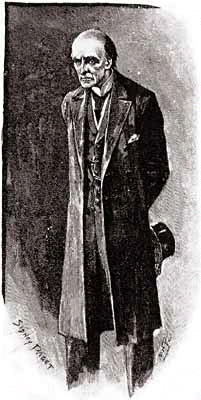
moriarty.gif What would happen if you put Dr. Moriarty in charge of solving Sherlock Holmes’ cases?
The Government and Accountability Office (GAO) has concluded that the Federal Communications Commission does nothing with about four out of every five consumer complaints that it puts into a database and investigates. Even worse, the GAO could not discern from its survey of the FCC’s complaint process why the FCC takes no enforcement action with 83 percent of the complaints it looked into from 2003 through 2006. “Without key management tools, FCC may have difficulty assuring Congress and other stakeholders that it is meeting its enforcement mission,” the GAO report warns. That’s putting it mildly. If the FCC does set up some serious net neutrality guidelines for ISPs like Comcast, how can P2P application users and other consumers know that the agency will take their comments seriously?

FCC living in the dark ages; a threat to net neutrality aims, By Matthew Lasar, ars technical, March 16, 2008 – 12:22PM CT

You might get about 7% of them solved, just to make a pretense of credibility.

Indeed, there is an assurance problem. Continue reading

Snooping as Free Speech: Verizon Claims Revealing Sensitive Customer Data is Its Right

Straw+Man.png It’s a good thing I hadn’t had my coffee yet:
Verizon is seeking to have a lawsuit filed against it for allegedly illegally helping the government eavesdrop on its customers and data mine their call records dismissed. The company argues that the suit infringes on the company’s First Amendment rights.

Verizon: Suing Us For Turning Over Customer Call Records Violates Our Free Speech Rights, By Ryan Singel ThreatLevel, May 04, 2007 | 5:59:00 AM

This is so funny I would have sprayed the coffee.

Funny in a gallows-humor kind of way. As in Verizon must be really desperate to try something like this. And as in the U.S. is in a bad way when telcos have apparently been handing over all their traffic to a secret spy agency and a court will even entertain an argument that their doing so is free speech. At least the judge in question has thus far allowed suits against Verizon in these matters to proceed. Maybe he will in this case, too.

If there were a real market for telecoms and ISPs in the U.S., this sort of thing would be less likely to happen, because some of the affected companies would possibly make a point of refusing to spy on their own customers, and would be rewarded by gaining customers.

-jsq

Jettisoned: 8 Centuries of Common Carriage Law

puzzle-grey-data-header.jpg Someone at CAIDA (presumably kc Claffy by the writing style), went to
an invitation-only intensely interactive workshop on the topic of Internet infrastructure economics. participants included economists, network engineers, infrastructure providers, network service providers, regulatory experts, investment analysts, application designers, academic researchers/professors, entrepreneurs/inventors, biologists, oceanographers. almost everyone in more than one category.

internet infrastructure economics: top ten things i have learned so far, by webmaster, according to the best available data, October 7th, 2007

and wrote up a report including this summary of the political situation:
…and it turns out that in the last 5 years the United States — home of the creativity, inspiration and enlightened government forces (across several different agencies) that gave rise to the Internet in the first place — has thoroughly jettisoned 8 centuries of common carriage law that we critically relied on to guide public policy in equitably provisioning this kind of good in society, including jurisprudence and experience in determining ‘unreasonable discrimination’.

and our justification for this abandonment of eight centuries of common law is that our “government” — and it turns out most of our underinformed population (see (1) above) — believes that market forces will create an open network on their own. which is a particularly suspicious prediction given how the Internet got to where it is today:in the 1960s the US government funded people like vint cerf and steve crocker to build an open network architected around the ‘end to end principle’, the primary intended use of which was CPU and file sharing among government funded researchers. [yes, the U.S. government fully intended to design, build, and maintain a peer-to-peer file-sharing network!]

That’s right folks: “resource sharing” was the buzzword back then, and every node was supposed to be potentially a peer to every other. Continue reading

Kaput: What Your Domain Becomes if U.S. Treasury Says So

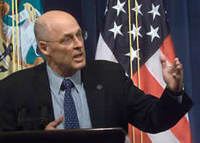
henrypaulson.jpg What a reputation:
So that’s that. Register your domain name through a U.S. company and your business goes kaput if the U.S. Treasury Department decides it doesn’t like you. It doesn’t matter if you’re based in Spain, your servers are in the Bahamas, your customers are mostly European, and you’ve broken no laws. No warning. Just kaput.

Just Kaput, Kevin Drum, Political Animal, 4 March 2008

This blogger bases his opinion on a NYTimes story: Continue reading

Back to the Future: 10Mbps by 2012, or, What Japan Had Years Ago

marketshare.gif Creeping ahead:
A study from Texas-based research firm Parks Associates predicts that 33 million US households will have broadband connections of 10Mbps or faster by 2012. As of the end of 2007, that figure stood at 5.7 million, which means that a lot of change will have to occur in the US market for that 33 million figure to become a reality.

Report: 10Mbps broadband in 33 million homes by 2012, By Eric Bangeman, ars technica, Published: March 04, 2008 – 10:20PM CT

Meanwhile, Japan is already doing 100Mbps. But in Japan there is real ISP competition. Unlike in the U.S., where, as shown in the pie chart by Park Associates (via DSL Reports), each of Comcast and AT&T have a fifth of the broadband market, followed by Verizon and Time Warner each with 13%, plus Cox with 7%, and that’s 3/4 of the total market served by only five companies, of whom most people have a choice of only two in any given locality. That’s not competition.

-jsq

Five of Thousands: Requests FISA Court Rejected

fisa_bar_graph.gif This is what the supporters of retroactive immunity think wasn’t sufficient: EPIC compiled a table of FISA Court cases. From 1979 through 2006, FISC heard thousands of cases and rejected only 5.

Retroactive immunity isn’t about protecting telcos: it’s about hoovering up everything, and it’s about a completely unconstrained “unitary executive”.

-jsq

Contempt: What CCIA has for Retroactive Immunity

ed-black-spyware.jpg
Ed Black by Declan McCullagh
It’s time somebody treated the fear-mongering about retroactive immunity as it d eserves:
CCIA dismisses with contempt the manufactured hysteria that industry will not aid the United States Government when the law is clear. As a representative of industry, I find that suggestion insulting. To imply that our industry would refuse assistance under established law is an affront to the civic integrity of businesses that have consistently cooperated unquestioningly with legal requests for information.

To the Members of the U.S. House of Representatives, Edward J. Black, President & CEO, Computer & Communications Industry Association, 29 February 2008

CCIA represents many of the corporations that are called upon by FISA.

-jsq