Verizon Does Something Right: No Hollywood Policing

tauke.190.jpg Verizon talks sense:
We see substantial increases in the volume of traffic. Generally we see that as a good thing. We have more customers paying for more services we provide.

—Tom Tauke, executive vice president for public affairs, Verizon, quoted in Verizon Rejects Hollywood’s Call to Aid Piracy Fight, By Saul Hansell, Bits, New York Times, February 5, 2008, 3:56 pm

He’s specifically responding to requests from Hollywood to police copyright. Tauke lists at least three good reasons not to:
  1. Slippery slope. What else? Pornography? Gambling?
  2. Liability. Especially for a deep-pockets company like Verizon.
  3. Privacy:
    Anything we do has to balance the need of copyright protection with the desire of customers for privacy.
A telco concerned with its customers’ privacy? I’d call that a good thing!

There is, nonetheless, a downside. Continue reading

Centralized Back Door in Protect America Act: Fails Do No Harm Test

bellovinblaze.jpg Matt Blaze has been spreading the word about a forthcoming paper by him and a Who’s Who of Internet security experts (Steve Bellovin and Matt Blaze are pictured to the right).
Although the Bush administration calls it a vital weapon against terrorism, its domestic wiretapping effort could become a devastating tool for terrorists if hacked or penetrated from inside, according to a new article by a group of America’s top computer security experts.

Domestic Wiretapping Could Pose ‘An Awesome Risk’ to National Security, By JUSTIN ROOD, ABC News, Feb. 1, 2008—

This is about the act passed last year that the Senate is debating extending or modifying right now. It’s that bad even before the administration strongarms Congress into approving retroactive immunity for the warrantless wiretapping it perhaps legitimizes, thus sweeping a host of illegal activities and other possible misdeeds under the rug.

What’s so bad about the Protect America Act? Continue reading

Shades of NSFNet: EDUCAUSE Proposes 100Mbps Nationwide Broadband

fibre.gif Shades of NSF:
EDUCAUSE, the association whose mission is to advance higher education by promoting the intelligent use of information technology, today proposed bringing the federal government, state governments, and the private sector together as part of a new approach to making high-speed Internet services available across the country.

The group, whose membership includes information technology officials from more than 2,200 colleges, universities, and other educational organizations, said that a new “universal broadband fund” would be necessary so that “Big Broadband” — services of 100 mbps — could be made widely available.

EDUCAUSE Proposes New Approach to Broadband Development, Wendy Wigen, Peter B. Deblois, EDUCAUSE, 29 Jan 2008

Back in the 1980s, in the time of standalone dialup Bulletin Board Systems (BBSes), the National Science Foundation (NSF) deployed a nationwide backbone network called NSFNet that eventually ran at the blazing fast for the times speed of 1.55Mbps. NSF also promoted development of NSFNet regional networks, many of which eventually figured in the commercialization of Internet that took off in 1991 when former dialup network UUNET started selling Internet connectivity and former personnel of an NSFNet regional formed PSINet and also started selling Internet connectivity.

Nowadays, when the fastest most people can get as so-called broadband is 1-3Mbps DSL from telcos or maybe 3-5Mbps from cablecos, maybe it’s time to do it again. Is this a plan that would work? Continue reading

Policing Cyberspace: any e-mail, file transfer, or Web search

022807-mcconnell-200.jpg A few days ago I remarked that potential loss of liability protection probably wouldn’t stop the telcos from filtering all Internet traffic because they’d get immunity, possibly in the FISA legislation currently being debated in the Senate. A few days later, the New Yorker revealed that the White House indeed has a plan for that:
“The real question is what to do about industry,” McConnell told me. “Ninety-five per cent of this is a private-sector problem.” He claimed that cyber-theft accounted for as much as a hundred billion dollars in annual losses to the American economy. “The real problem is the perpetrator who doesn’t care about stealing—he just wants to destroy.” The plan will propose restrictions that are certain to be unpopular. In order for cyberspace to be policed, Internet activity will have to be closely monitored. Ed Giorgio, who is working with McConnell on the plan, said that would mean giving government the authority to examine the content of any e-mail, file transfer, or Web search. “Google has records that could help in a cyber-investigation,” he said. Giorgio warned me, “We have a saying in this business: ‘Privacy and security are a zero-sum game.’ ”

The Spymaster, by Lawrence Wright, The New Yorker, 21 January 2008

Bruce Schneier has already demolished the “privacy vs. security” canard: it’s really liberty vs. control.

It figures that it would be Director of National Intelligence Mike McConnell pushing monitoring the whole Internet, since he’s one of the key figures behind retroactive telecom immunity for illegal warrantless wiretapping. That was a bad idea, and this is also a bad idea.

But it’s also why AT&T may have good reason to believe there’d be no liability for filtering the entire Internet.

-jsq

Retroactive Immunity and Administrative Discipline: It’s Not About Telcos

nixonillegal.320.240.jpg Retroactive immunity for whom?
Telecoms already have immunity under existing FISA law where they acted pursuant to written government certification or where they prove they acted in good faith (see 18 USC 2520 (d)). There is no reason that the federal courts presiding over these cases can’t simply make that determiniation, as they do in countless other cases involving classified information.

Jay Rockefeller’s unintentionally revealing comments, Glenn Greenwald, Unclaimed Territory, Salon.com, Thursday January 24, 2008 07:33 EST

There’s even a two year statue of limitations in the Code.

Here’s one version of what this is really about: Continue reading

Joel Johnson on Filtering on AT&T Online Show

The editor of BoingBoing Gadgets goes on an AT&T-sponsored online-only video show and asks about AT&T’s announcement that it will filter all Internet traffic. Getting no straight answers from the host, he asks the audience:
“Do you guys want AT&ampT to read your emails?”

“No!”

Do you want AT&T to like open up your instant message conversation to see if you said something they didn’t like or maybe the government didn’t like?”

“No!”

Talking About AT&T’s Internet Filtering on AT&T’s The Hugh Thompson Show BoingBoing Gadgets, Posted by Joel Johnson, January 21, 2008 5:23 AM

Johnson noticed that the crew of the show was not happy: Continue reading

Canadian Net Neutrality

cd.gif In Canada, an ISP has even gotten up to blocking striking employees’ website:
During the Telus strike in 2005, the corporation blocked access to a website run by striking Telus employees called “Voices for Change” (and at least 766 other websites). Those familiar with network-control issues in Canada also accuse Rogers and Bell of limiting peer-to-peer (P2P) applications, which people use to share audio, video and other digital data with one another. So, here we have ISPs blocking or at least limiting the use of what is likely the most innovative, creative and participatory use of the Internet. In response to customer concerns, Bell recently admitted that they “are now using Internet Traffic Management to restrict accounts that are using a large portion of bandwidth during peak hours. Some of the applications that are included are the following: BitTorrent, Gnutella, LimeWire, Kazaa….”

The Fight for the Open Internet, Steve Anderson, Canadian Dimension magazine, January/February 2008 issue

The rest sounds very familiar: Continue reading

Settling for Slow: Duopoly or Competition

CIR638.gif This is what the duopoly doesn’t want:
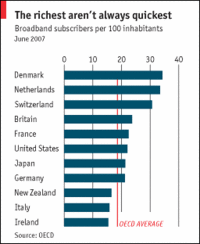
In France, for example, the regulator forced France Télécom to rent out its lines. One small start-up firm benefited from this opportunity and then installed technology that was much faster than any of its rivals’. It won so many customers that other operators had to follow suit. In Canada, too, the regulator mandated line-sharing, and provinces subsidised trunk lines from which smaller operators could lease capacity to provide service.

Open up those highways, The Economist print edition, Jan 17th 2008

The duopoly will settle for the U.S. being slow and expensive as long as they get to collect the rents.

Here’s how other countries do it: Continue reading

AT&T Filtering: Has Tim Wu Not Been Paying Attention?

Katharine_GrahamL.jpg
Katharine Graham
by Diana Walker
Tim Wu asks in Slate: Has AT&T Lost Its Mind? It seems he’s discovered that:
Chances are that as you read this article, it is passing over part of AT&T’s network. That matters, because last week AT&T announced that it is seriously considering plans to examine all the traffic it carries for potential violations of U.S. intellectual property laws. The prospect of AT&T, already accused of spying on our telephone calls, now scanning every e-mail and download for outlawed content is way too totalitarian for my tastes. But the bizarre twist is that the proposal is such a bad idea that it would be not just a disservice to the public but probably a disaster for AT&T itself. If I were a shareholder, I’d want to know one thing: Has AT&T, after 122 years in business, simply lost its mind?

No one knows exactly what AT&T is proposing to build. But if the company means what it says, we’re looking at the beginnings of a private police state. That may sound like hyperbole, but what else do you call a system designed to monitor millions of people’s Internet consumption? That’s not just Orwellian; that’s Orwell.

Has AT&T Lost Its Mind?A baffling proposal to filter the Internet. By Tim Wu, Slate, Posted Wednesday, Jan. 16, 2008, at 10:15 AM ET

Come now; what did you think they were up to? Continue reading