Freedom v. Market Mythology

art_brodsky.jpg Here’s a question that answers itself:
…what is it about individual freedom that “conservatives” like the Spectator and Armey don’t like?

To be fair, the debate is larger than the Spectator and Armey. Most congressional Republicans oppose the idea of giving consumers freedom on the Internet. They take shelter in their anti-government, anti-regulation rhetoric, preferring to allow Internet freedom to apply to the corporations which own the networks connecting the Internet to consumers, rather than to consumers themselves. There could, of course, be a larger discussion about the meaning of “conservative” and Republican, and whether the two are synonymous.

(To be fairer still, it’s not only Republicans. Many a Democrat also speaks out against Internet freedom. They don’t have the fig-leaf of misbegotten ideology to hide behind, as they largely back worthwhile government action in many other areas. They are simply servants of corporate and/or union interests. The question applies equally: What about freedom don’t they like?)

Why The ‘Right’ Gets Net Neutrality Wrong, Art Brodsky, HuffingtonPost, Posted May 5, 2008 | 10:21 AM (EST)

The clue is “servants of corporate … interests”. (Unions occasionally get into this act; corporations much more frequently.) And it’s not simple greed for corporate lobbyist money or kickbacks or the revolving door: many politicians and people really believe the “free market” will solve all problems. That’s the origin of the doctrine of “market failure” that has pervaded all U.S. federal departments and agencies. Nevermind that when it’s a major airline or automobile manufacturer or, even worse, a financial institution such as Citibank, these same people support all sorts of governmental market manipulations and bailouts. We’re talking mythology here, kind of like the “rational actor” myth of economics.

Brodsky digs into the misconceptions behind this myth:

[Peter] Suderman’s analysis: “In fact, not only were all of these companies [eBay and Google] born in an era with no mandated net neutrality, it’s utterly unclear that a lack of neutrality would’ve impeded them in any way whatsoever.”
That is not how it happened. This is how it happened: Continue reading

Anti-Trust Still Not Appropriate for Net Neutrality

farber-10.jpg I admire Dave Farber; he’s done a lot for computing and the Internet. But sometimes I can’t agree with him:
Antitrust law generally takes a case-by-case approach under which private parties or public agencies can challenge business practices and the courts require proof of harm to competition before declaring a practice illegal. This is a sound approach that has served our economy well.

Hold Off On Net Neutrality, By David Farber and Michael Katz, Interesting People, Friday, January 19, 2007; A19,

In an op-ed he’s recently reposted on his Interesting People list, he’s recommending antitrust instead of legislation to deal with net neutrality. So far as I know, Farber is no lawyer. In this case, I tend to go more by lawyers who have actually studied the problem, for example Prof. Barbara Cherry, who used to work for the FCC and has examined the history of common, statutory and administrative law in the U.S., as well as the way Internet provision has been wrenched out of one legal regime into another by the FCC, and how the FCC has also stripped broadband of its common carriage status. Those who say that we shouldn’t regulate because we don’t know what will happen and anti-trust will catch problems if they occur are not taking into account that anti-trust doesn’t automatically apply to or address problems in the new legal regime into which broadband has been thrust.

-jsq

Blocking Civil Suits: Telecoms Lobbied White House Hard for Immunity

burgess07-1a.jpg Well, it seems the telcos are a bit worried about those lawsuits:
The Bush administration is refusing to disclose internal e-mails, letters and notes showing contacts with major telecommunications companies over how to persuade Congress to back a controversial surveillance bill, according to recently disclosed court documents.

The existence of these documents surfaced only in recent days as a result of a Freedom of Information Act lawsuit filed by a privacy group called the Electronic Frontier Foundation. The foundation (alerted to the issue in part by a NEWSWEEK story last fall) is seeking information about communications among administration officials, Congress and a battery of politically well-connected lawyers and lobbyists hired by such big telecom carriers as AT&T and Verizon. Court papers recently filed by government lawyers in the case confirm for the first time that since last fall unnamed representatives of the telecoms phoned and e-mailed administration officials to talk about ways to block more than 40 civil suits accusing the companies of privacy violations because of their participation in a secret post-9/11 surveillance program ordered by the White House.

At the time, the White House was proposing a surveillance bill—strongly backed by the telecoms—that included a sweeping provision that would grant them retroactive immunity from any lawsuits accusing the companies of wrongdoing related to the surveillance program.

Just Between Us, Telecoms and the Bush administration talked about how to keep their surveillance program under wraps. by Michael Isikoff and Mark Hosenball, TERROR WATCH, Newsweek, Apr 30, 2008 | Updated: 6:09 p.m. ET Apr 30, 2008

It’s sad to see professional military men like Lt. General Ronald L. Burgess, Jr., Office of the Director of National Intelligence, shilling for an administration that is so blatantly protecting itself and big corporations against justice for its own wrongdoing. White House stonewalling over first the existence of these documents, and now, since a judge ordered them to reveal that, release of the documents, isn’t about any “war on terror”. It’s about protecting lawbreakers and control of the people: Continue reading

Sitcoms as Gin, or, Looking for the Mouse

Clay Shirky explains why sitcoms serve the same function as gin did in industrial revolution Britain:

Transcript.

This is why traditional media fear the Internet. They have been supplying the gin to keep us all intoxicated instead of doing anything participatory or useful with our leisure time. The Internet (and gaming, and computers in general) provides ways of interacting and participating at every scale from local to global that have never existed before. And people are starting to use them.

Think about that the next time somebody equates “screen time” for television and the Internet.

-jsq

Murdoch Wants Another NYC Newspaper

murdoch2_AP_2.jpg
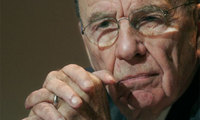
Rupert Murdoch AP Photograph
Four months after Rupert Murdoch bought the Wall Street Journal, the editor quit. Murdoch already owns the New York Post. Now he wants to buy Newsday. Nevermind that such a purchase would be illegal. The good money is on Kevin Martin’s FCC letting it happen anyway. After all, if he doesn’t need a law to enforce, what’s to stop him not enforcing the laws he’s already got?

Despite having had no success at preventative or forensic oversight of the FCC, Congress is going to give it another go:

However, the looser ownership rules the FCC passed in December – over an outcry from many interest groups – has stirred criticism from many in Congress, suggesting that Murdoch’s Newsday bid faces the first stirrings of a backlash.

The commerce committee in the Senate yesterday approved a “resolution of disapproval” measure that would overturn the new ownership rules, creating more of a hurdle for Murdoch.

Senator Byron Dorgan, the measure’s leading sponsor, said: “We really do literally have five or six major corporations in this country that determine for the most part what Americans see, hear and read every day. I don’t think that’s healthy for our country.”

Dorgan is backed by 25 senators, including Democratic presidential candidates Hillary Clinton and Barack Obama, and is confident it will pass the Senate. A similar bill has been proposed in the House.

Murdoch’s Newsday bid faces hurdle, Elana Schor, guardian.co.uk, Friday April 25 2008

We’ll see if the Senate or Democrats have a spine this time.

Meanwhile, the entire mainstream press, except the New York Times, ignores that the president of the United States admits he personally authorized war crimes. Except for ABC, which broke the story, but then couldn’t be bothered to mention it during a “debate” it hosted between the remaining Democratic presidential candidates.

If every other major paper in NYC (and 3 out of the top 10 in the U.S.) is controled by Murdoch, how long before the NYTimes falls prey, too? With net neutrality we can still know about stories like this. Without it?

-jsq

Hamlet in DC: To Legislate or Not to Legislate, That is the Question

EdwinBoothasHamlet.jpg The U.S. Senate takes up net neutrality again, to legislate or not to legislate:
At a Senate Commerce Committee hearing entitled “The Future of the Internet” on Tuesday, Democratic politicians argued for passage of a law designed to prohibit broadband operators from creating a “fast lane” for certain Internet content and applications. Their stance drew familiar criticism from the cable industry, their Republican counterparts, and FCC Chairman Kevin Martin, who said there’s no demonstrated need for new rules, at this point.

Net neutrality battle returns to the U.S. Senate, by Anne Broache, C|Net News.com, 22 April 2008

Some of the senators seemed to think the Comcast debacle indicated there was need for legislation:
“To whatever degree people were alleging that this was a solution in search of a problem, it has found its problem,” said Sen. John Kerry (D-Mass.). “We have an obligation to try and guarantee that the same freedom and the same creativity that was able to bring us to where we are today continues, going forward.”

Kerry is one of the backers of a bill called the Internet Freedom Preservation Act, chiefly sponsored by North Dakota Democrat Byron Dorgan and Maine Republican Olympia Snowe, which resurfaced at the beginning of 2007 but has gotten little attention since. A similar measure failed in a divided Commerce Committee and in the House of Representatives nearly two years ago.

Unsurprisingly, Martin says he doesn’t need a law to enforce, because he can make it up as he goes along: Continue reading

NFL v. Comcast: Expect this on the Internet

nfl.gif This is what we can expect to see on the Internet if the duopoly is left to its own devices:
NFL Network is filing a complaint with the Federal Communications Commission against cable TV giant Comcast in the latest legal wrangling between the two.

The network announced Thursday it had served Comcast with the required 10-day notice of its intent to file a complaint. NFL Network is accusing the nation’s largest cable operator of discriminatory and anticompetitive treatment in violation of the Cable Act of 1992.

The two sides have been feuding over Comcast’s decision to place NFL Network on a premium sports tier that customers must pay extra to receive. NFL Network sued Comcast in October 2006 over the move.

NFL Network filing complaint with FCC against Comcast AP, 17 April 2008

The NFL Channel and the Amazon Channel. Whatever the duopoly thinks it can milk for extra revenue by putting it on a premium channel, that’s what they’ll do.

Defenders of the duopoly may claim they’re doing it to protect copyright, but note that in this case the content provider doesn’t even want it.

-jsq

ISPs Escalate Ignoring FCC

comcast.jpg Fox started the trend of ignoring the FCC when it does something they don’t like. Now the duopoly has gotten up to the same trick:
Comcast, AT&T, Time Warner Cable, and cable research company CableLabs were all invited to participate several weeks ago, but declined, Martin said. The commission again reached out to Comcast after the announcement this week that it would develop a P2P bill of rights with Pando Networks, but they again sent their regrets, he said.

ISPs Give FCC Cold Shoulder at Internet Hearing, by Chloe Albanesius, PCMag.com, 04.17.08

You may recall at the previous hearing, at Harvard, FCC chair Kevin Martin couldn’t hear the difference between participant and consumer, while Comcast hired shills off the street to take up seats so people with things to say couldn’t. Now the duopoly is painting the FCC as unduly critical of themselves, and the press is going along with that, including the hometown Silicon Valley newspaper, the San Jose Mercury News, which should know better: Continue reading

Abyss: What You Won’t Hear Without the Internet

tim-robbins.jpg Tim Robbins, famous actor, writer, director, and producer, was invited by the National Association of Broadcasters to give a talk. Then they turned off all the cameras. But they forgot to tell the audience to turn off their voice recorders:
Now some of you are concerned with that unrelenting pesky competition. You know, the new technologies; the Internets and satellite radio and television. The problem is there are too many people in this country that take the notion of creativity and invention too damn seriously. Just when one technology is centralized, conglomerated, monopolized, along come new technologies and delivery systems to threaten the good work born of deregulation. Just when we were getting close to a national playlist for our music, satellite technology is threatening to provide music that people actually want to hear. Just when we were close to a national news media, providing a general consensus on what the truth is, along comes the Internets that allow its users a choice on the kinds of news it watches. And the You Tube. My God we’ve got to stop them. Recently when we were about to enjoy our great national pastime of ‘tearing apart a presidential candidate with relentless repetition of ugly things his friend said’, You Tube provided the candidates reasoned response and millions watched and responded positively.

Well you here at NAB have the power to stop this dangerous technology. The question is, how? I respectfully suggest that you do what others have done when facing the competition of new technologies. Get compromising information on your enemy and expose them in a sex scandal. Or call them a racist, or better yet a traitor. That not only undermines your competitor, but provides the public with fantastic entertainment.

The Power and Responsibility of our Nation’s Broadcasters, By Tim Robbins, The following is my opening keynote speech for the National Association of Broadcasters Show in Las Vegas, which I delivered Monday night. 14 April 2008

He had a fine time lampooning that the news media do all the time. And then he got serious: Continue reading

Panopticon Click: NYTimes and Wapo Catch on to Packet Privacy

Panopticon.jpg When both the New York Times and the Washington Post catch on, the idea of online privacy protection from ISPs must be catching on:
It’s not paranoia: they really are spying on you.

The Already Big Thing on the Internet: Spying on Users, By ADAM COHEN, New York Times, Published: April 5, 2008

Some specifics:
The online behavior of a small but growing number of computer users in the United States is monitored by their Internet service providers, who have access to every click and keystroke that comes down the line.

Every Click You Make: Internet Providers Quietly Test Expanded Tracking of Web Use to Target Advertising By Peter Whoriskey, Washington Post Staff Writer, Friday, April 4, 2008; Page D01

Some say privacy is only distant nostalgia; I say we need to do something about it. We need packet privacy.

Laissez faire won’t get ‘er done. As Cohen writes: Continue reading