Apparently people have trouble imagining what
a telco-packaged non-neutral Internet
would look like.
Think of cable TV.
Look at AT&T’s Blue Room.
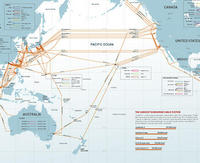
Or look at
this graphic,
which apparently was originally drawn in May 2006.
Google may be getting into international infrastructure as well as domestic:
Google is planning a multi-terabit undersea communications cable across
the Pacific Ocean for launch in 2009, Communications Day has learned.
The Unity cable has been under development for several months, with a
group of carriers and Google meeting for high-level talks on the plan
in Sydney last week.
Google would not strictly confirm or deny the existence of the Unity
plan today, with spokesman Barry Schnitt telling our North American
correspondent Patrick Neighly that “Additional infrastructure for the
Internet is good for users and there are a number of proposals to add
a Pacific submarine cable. We’re not commenting on any of these plans.”
However, Communications Day understands that Unity would see Google
join with other carriers to build a new multi-terabit cable. Google
would get access to a fibre pair at build cost handing it a tremendous
cost advantage over rivals such as MSN and Yahoo, and also potentially
enabling it to peer with Asia ISPs behind their international gateways
– considerably improving the affordability of Internet services across
Asia Pacific.
Steven Levitt points out there are other ways to measure the
effects of a military action than listening to politicians or generals,
and the Internet can promote the production of such measures,
and the analysis of them by multiple parties.
On several measures, M.I.T. professor
Michael Greenstone
finds results of the U.S. “surge” in Iraq to be mixed.
Then he brings in another measure:
The most interesting part of Greenstone’s paper is his analysis of the
pricing of Iraqi government debt. The Iraq government has issued bonds
in the past. These entitle the owner of the bond to a stream of payments
over a set period of time, but only if the government does not default
on the loan. If Iraq completely implodes, it is highly unlikely that
these bonds will be paid off. How much someone would pay for the rights
to that stream of payments depends on their estimate of the probability
that Iraq will implode.
The bond data, unlike the other sources he examines, tell a clear story:
the financial markets say the surge is not working. Since the surge
started, the market’s estimate of the likelihood of default by the
Iraqi government has increased by 40 percent.
This kind of analysis seldom gets written for traditional channels
because (2) there’s no academic incentive for it and (3) the only money
in it is usually from special interests.
Here’s the main point:
1. This paper shows how good economic analysis can contribute in a
fundamental way to public policy. Anyone who reads Greenstone’s article
will recognize that it is careful and thorough. It is even-handed and
apolitical. It combines state-of-the-art data analysis techniques with
economic logic (e.g., using market prices to draw conclusions about how
things are going).
…
4. The internet can potentially solve both problems (2) and (3) above,
leading to an increased supply of good, timely analysis. If people like
Greenstone can immediately get their findings into the public debate
through the internet, it gives a real purpose (not just an academic
one) to doing the work. In addition, there are now online peer-reviewed
academic journals that have greatly sped the time from submission to
publication, potentially increasing the academic payoff to someone like
Greenstone. With many respected economists now blogging, there is also
a vehicle for these folks to weigh in on the quality of policy-related
economic writings — like I am doing in this blog post.
If the Internet helps focus many eyes on bugs and make them shallow,
why can’t it do the same with political and military actions?
Right now it can.
Without net neutrality it wouldn’t be able to.
Two years ago the New York Times made its best marketing estimate
of how to derive income from the web, and put many of its back stories
beyond a paywall called TimeSelect, at $49.95/year or $7.95/month.
Times change:
In addition to opening the entire site to all readers, The Times will also make available its archives from 1987 to the present without charge, as well as those from 1851 to 1922, which are in the public domain. There will be charges for some material from the period 1923 to 1986, and some will be free.
The Times said the project had met expectations, drawing 227,000 paying subscribers — out of 787,000 over all — and generating about $10 million a year in revenue.
“But our projections for growth on that paid subscriber base were low, compared to the growth of online advertising,” said Vivian L. Schiller, senior vice president and general manager of the site,
NYTimes.com.
What changed, The Times said, was that many more readers started coming to the site from search engines and links on other sites instead of coming directly to NYTimes.com. These indirect readers, unable to get access to articles behind the pay wall and less likely to pay subscription fees than the more loyal direct users, were seen as opportunities for more page views and increased advertising revenue.
“What wasn’t anticipated was the explosion in how much of our traffic would be generated by Google, by Yahoo and some others,” Ms. Schiller said.
This is why it’s a bad idea to let the telcos and cablecos determine
what we can see or do on the web.
Nobody can predict what will work best, especially for deriving revenue.
Hm, this would also mean that the duopoly’s insistence on TV as the
future of Internet revenue could be just as wrong for them
as it is for the rest of us.
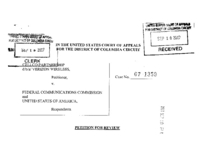
Verizon Wireless seeks judicial review on the grounds that the
Report and Order exceeds the Commission’s
authority under the Communications Act of 1934,
as amended, 47 U.S.C. §§ 151, eg. seq.,
violates the United States Constitution,
violates the Administrative Procedure Act, 5 U.S.C. § 701 et. seq.,
and is arbitrary capricious, unsupported by substantial evidence
and otherwise contrary to law.
Curious how the burden of proof always seems to be on anybody
but the telcos and cablecos.
I mean, didn’t the FCC get the memo that it was only supposed
to do anything if somebody proved
market failure?
That’s Internet freedom.
That’s why we need net neutrality.
What is net neutrality?
If I pay to connect to the Net with a certain quality of service, and
you pay to connect with that or greater quality of service, then we can
communicate at that level.
Where you and I are any pair of participants on the Internet.
Continue reading →
House telecom subcommittee Chairman Edward Markey (D-Mass.) repeated his
call for the Federal Communications Commission to investigate widespread
allegations of telecom privacy law violations by intelligence agencies
that received cooperation from telecom carriers in anti-terrorist
surveillance efforts.
That would be about as likely as Gonzales starting such an investigation.
Oh, wait:
After Markey wrote Martin in March to ask him to launch an investigation
into whether telecom privacy laws have been broken, the FCC chairman
wrote Attorney General Alberto Gonzales to verify that the agency
could not conduct such a probe because it would violate federal laws
governing disclosure of state secrets. Gonzales, who recently announced
his resignation, has yet to respond to Martin.
The Federal Communications Commission is considering whether to reduce
restrictions on broadcast-station ownership, an action that would permit
greater media and press concentration.
This is a bad idea. Bad for audiences, for citizens, and for
democracy. Dispersed media ownership, ideally local ownership, serves
democratic values, while conglomerate ownership and media mergers, which
would be the result of reduced ownership restrictions, do the opposite.
Equality — one person one vote — provides the proper standard for
the distribution of power and voice in a democracy. Maximum dispersal
of media ownership can enable more people to identify a media entity as
in some sense speaking for and to them.
Dispersed ownership also reduces the danger of inordinate, potentially
demagogic power in the public sphere. As the FCC once recognized,
many owners creates more independent decision makers who can devote
journalistic resources to investigative reports. Finally, dispersal
reduces — without eliminating — potential conflicts of interests
between journalism and an owner’s economic interests.
In contrast, media mergers put papers and broadcasters into the hands of
executives whose career advancement depends on maximizing profits. Mergers
require owners to squeeze out more profits to pay off debt created by the
high bid made to secure the purchase. As too many recent examples show,
the most consistent method to reduce expenses is to fire journalists.
There’s more. It’s all good.
And it’s by a law professor who has written a book on the subject,
so he appears to have researched it.
Continue reading →
A free-for-all web (after normal monthly broadband charges have been
paid) is one of the wonders of the world and a binding force for all
communities.
…
The Federal Communications Commission has just been advised by the US
department of justice, under heavy lobbying from the operators who stand
to gain from higher data charges, that a neutral net might “prevent,
rather than promote” investment and innovation. This is twaddle. An
open-access net has produced one of the greatest surges of innovation
ever recorded and has given an opportunity for people all over the world
to communicate with each other and share knowledge on equal terms. Long
may it continue to be so.
It has only become an issue because the US Congress is scrutinising the
question of “net neutrality”, though why the US authorities – rather than
an international body – should deem themselves to have jurisdiction over
the internet is not clear.
The ITU defines “NGN” as a network that provides
quality-of-service-enabled transport technologies. The idea is that
packet transport will be “enriched with Multi Protocol Label Switching
(MPLS) to ensure Quality of Service (QoS).”
Translation, as far as I can tell: packet transport becomes the same
as circuit-switched transport. Prioritization is controlled; it’s a
network optimized on billing.
—
Tying things together,
by Susan Crawford,
Susan Crawford blog,
Mon 10 Sep 2007 08:05 PM ED
This takes us back to the bad old days when national telephone companies
sold you data service by the byte, through their preferred protocol, X.25.
The advantage of circuit switching was supposed to be fully provisioned
copper wires or other resources all the way through between two parties.
The disadvantages were that you sometimes couldn’t get a connection
and the high price, which got even higher between countries.
It seems the telcos have settled on MPLS as their modern equivalent of X.25.