The Federal Communications Commission is seeking to shut the door on a plan by a group of Silicon Valley entrepreneurs to offer free wireless broadband Internet service everywhere in the U.S., the chief executive of the group said Wednesday.Why would the FCC object to that? Continue readingM2Z Networks Inc. issued a statement Wednesday in which it said it would take the FCC to court in an attempt to force the agency to conduct a thorough analysis of the plan before it determined whether it would back it or not.
The company has proposed taking 25 megahertz of spectrum that is currently vacant and using it to build a wireless broadband Internet network to provide free service to 95% of Americans within a decade.
— UPDATE: FCC Opposes Silicon Valley VCs’ Free-Broadband Plan, (Updates with comment from Rep. Anna Eshoo, D-Cal., in the fifth paragraph.) By Corey Boles, Dow Jones, August 15, 2007: 05:14 PM EST

700Mhz: Duopoly As Usual
Susan Crawford reads the
700Mhz auction rules
and confirms the worst:
1. Those Carterfone protections don’t mean too much. The no-locking, no-blocking requirements are hedged in by substantial limitations: the winning licensee will be able to lock and block devices and applications as long as they can show that their actions are related to “reasonable network management and protection,” or “compliance with applicable regulatory requirements.” In other words, as long as the discrimination can be shown to be connected (however indirectly) to some vision of “network management,” it will be permitted. (Discrimination “solely” for discrimination’s sake is prohibited, but that’s not too difficult to avoid.)So it’s ILECs vs. CLECs, round two. Guess who’ll win?— Many, many devils in the details: 700 MHz rules, by Susan, from Susan Crawford blog, 13 Aug 2007
And even supposedly Cmr. Copps “grudgingly accepted” these rules. Seems to me we need a whole new FCC, so we can get some real rules of the road.
And what we really need is some real competition.
-jsq
Chicago’s Most-Read Columnist
Why newspapers pay attention to blogs:
Then she’ll post it, under the screen name Georgia10, on the front page of liberal blog Daily Kos (dailykos.com), which gets between 400,000 and 800,000 unique visitors daily. The Tribune’s daily circulation, just for some context, is about 586,000; its Web site gets a little over three million unique visitors per month, which averages out to around 100,000 a day. (The Tribune won’t release stats on how many visitors its blogs or news columnists get.)Georgia Logothetis, now 24, was a 23 year old college student when that article was written, and she was already the most-read political columnist in Chicago. This doesn’t tend to happen in newspapers. It can happen online, where the management pyramid can be mighty flat.— Whois is Georgia10? by Christopher Hayes, Chicago Reader, fall 2006
How did she do it? Political connections? Graft? Tokenism? Nope. Many hours of research, and
More than a deft prose style and an outraged disposition, the trait held in the highest regard in the lefty blogosphere is prodigiousness. The more you post, the more readers you attract, and on this front, Georgia10 is the site’s workhorse.Merit can win online.
-jsq
Pearl Jam Censored by AT&T?
|
After concluding our Sunday night show at Lollapalooza, fans informed us that portions of that performance were missing and may have been censored by AT&T during the “Blue Room” Live Lollapalooza Webcast.So, “a mistake”.When asked about the missing performance, AT&T informed Lollapalooza that portions of the show were in fact missing from the webcast, and that their content monitor had made a mistake in cutting them.
— LOLLAPALOOZA WEBCAST: SPONSORED/CENSORED BY AT&T? News, PearlJam.com, 7 August 2007
Uhuh.
But it gets better. Continue reading
Russian Roulette
FCC Commissioner Michael Copps has a way with words.
Last year he said we should be talking about
Internet freedom rather than net neutrality.
And now he says we’re
playing Russian roulette with broadband and Internet and more traditional mediaAnd the Russians are winning. Continue reading— FCC Commissioner: US playing “Russian roulette with broadband and Internet” By Nate Anderson, ars technica, August 03, 2007 – 09:20AM CT
French FttH
In the U.S.,
it’s difficult for a municipality to put up
a wireless Internet service even if it’s a disaster zone
and the telco hasn’t gotten its POTS service back up,
because the duopoly doesn’t want the competition.
Meanwhile, in France:
Municipalities, cities, states, territories and regions are driving the French municipal (wireless and wired) broadband uptake as newly authorized by law. A new article of French “code général des communications” passed in June 2004 (law ref code is L-1425-1) gives these public entities the following rights :The municipality does have to demonstrate that there isn’t already a similar service, but given the “open networks” aspect, that shouldn’t be difficult. Could this have something to do with why France is ahead of the U.S. in Internet connectivity and speed?
- build, subsidize and develop “passive” telecom infrastructure and provide/transfer them to carriers or independent local users.
- build open networks on a given territory and provide/transfer them to a territorial carrier.
- operate open telecommunications networks in respect of regulations.
- provide telecommunications services to end users.
— Municipal broadband in France, by Esme Vos, MuniWireless, at 7:42 PM on September 5, 2005
Apparently so:
Nowadays there are over a hundred projects, small and big. One famous one One famous one is the plan to do FttH in Hauts-de-Seine, the department chaired by Mr Sarkozy until he became President. Sarkozy was the man personally proprosing the FttH roll out in Hauts de Seine.He points out that picture FCC Commisioner Tate and ARCEP Commissioner Gauthey have met, as in the picture. Perhaps soon we’ll get a U.S. president who might be influenced by French president Sarkozy on this subject.— Some French muni BB inspiration to Maybe Rep’s Boucher & Upton? Dirk H. van der Woude, Interesting People, 5 August 2007
-jsq
Common Sense Conversation
In case it wasn’t clear why the Internet is different from traditional
broadcast news media:
…news is no longer a one-way process. It is now much more of a conversation between journalist and reader. Reporters at major news organizations no longer have the omnipotent authority they once had. The news process, in a word, has been democratized. Readers feel entitled to get just the information they want, in the form they want it. They feel entitled to talk back. Slowly but surely, we reporters are beginning to accept that readers do actually have this right, and that the feedback can make us better, not worse. As the old New Yorker writer A.J. Liebling once put it, “I think democracy a most precious thing, not because any democratic state is perfect, but because it is perfectible.”A conversation? Not controled by the few big media companies that control most other media? Now that sounds dangerous doesn’t it? Dangerous like Common Sense.— The MSM vs. the blogosphere, by Michael Scherer, War Room, Salon, 3 August 2007
-jsq
It’s Good to be King!
How are those
merger conditions coming along?
Remember the story back in June about how AT&T had extremely quietly started offering $10 DSL as was required in its deal to buy BellSouth? The company was promoting many other, more expensive, DSL options, but the only way you could get the required $10 version was if you specifically knew to ask about it. Broadband Reports points to an interview from an Atlanta newspaper with AT&T CEO Randall Stephenson where he’s asked about the $10 DSL. The interviewer points out that no story about AT&T resulted in a more irate response from AT&T customers as its story about the hidden offer for $10 DSL, suggesting that this was a huge issue for AT&T customers. Stephenson’s response? First he denies that the company made it hard to find, and then he says that they’re not promoting it because customers don’t want it. This, despite the clear response from customers to the very newspaper who was conducting the interview. Then, he basically admits that the $10 DSL doesn’t work very well, saying that they don’t promote it because they don’t want to give customers a product that sucks. Of course, he says that as if it’s not his company that has quite a bit of control over whether or not the product sucks.This is even though the AJC reporter introduced the question with:— AT&T CEO: We Don’t Promote $10 DSL Because No One Wants It, Techdirt, 1 August 2007
Of all the things the AJC has written about AT&T lately, none has caused more reader irritation than AT&T’s $10 a month DSL offer, which was required by the Federal Communications Commission when you bought BellSouth.The techdirt writer goes on to point out that this is what SBC used to do with naked broadband, too, i.e., dance around and do nothing. After all, without regulation or competition, it’s good to be king!— Q&A: AT&T CEO Randall Stephenson, By Scott Leith, The Atlanta Journal-Constitution, Published on: 07/27/07
-jsq
Mergers + Bad Regulation = Higher Prices
What hath mergers wrought?
AT&T and MCI long distance increased over 200+% since 2000 for low volume users, 80% increase in Verizon local service in New York City since 2000, 472% since 1984, new bogus late fees or ‘shortfall’ fees, a 29% increase of the Universal Service Fee since 2006, and increases to every service, from packages, toll calls, and calling features to inside wire maintenance — it goes on and on. Worse, plans are being made to increase the FCC Line Charge to $10.00, increase Universal Service and even add new fees.Mergers and bad regulation, that is.Competition was supposed to lower prices. Instead, America’s phone customers have been taken advantage of, especially low income, low volume users, and seniors. Teletruth has received multiple AT&T and Verizon bills ALL showing major increases, new charges, and new problems. If competition did exist for local, long distance, packages, etc. then all of these increases would not have happened.
— AT&T and Verizon Local and Long Distance NJ and NY Phone Bills Show Massive Price Increases. Phone Mergers and a Lack of Competition Are to Blame. FCC Phone Rate Data Are Hiding the Problems. TeleTruth News Alert, 25 July 2007
The Martin 700Mhz wireless acution plan leaves the same two big incumbents, AT&T and Verizon, in place. And Verizon is probably going to be a bit bigger soon, once it absorbs RCCC. Should we expect a different outcome this time?
-jsq
RCCC Stock Up Just Before 700Mhz Auction
Previously I wondered where the big wireless telephone carriers
would find enough bandwidth to buy outside the pending 700Mhz auction,
as
Republican Commissioner Robert M. McDowell suggested.
Well, the place to look is the stock market.
A day before the FCC decision of yesterday,
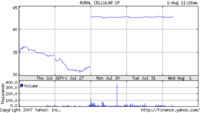
the stock of Rural Cellular Corp (RCCC) went up about 30%
on
news that Verizon was buying RCCC.
Such a sale has to have been pending for some time; probably at least
six months.
So it seems that McDowell’s assertion is useful political cover for Verizon,
if not prediction of future acquistions.
Maybe both; I guess we’ll see.
-jsq